That was the sage advice from Bill Gorta, of the New York Post, a former cop turned journalist, who offered it up as his main tip to us — or in other words, don’t live and die amongst other journalists — get out and experience other things.
This week has been plagued by more repetitive lectures, orientations, drills, et cetera. So far, (and at least one student agrees with me) I’ve found that we have a great deal of exercises about writing short stories, headlines, and all that. I think that’s it’s pretty rudimentary and that you probably wouldn’t be in the school if you couldn’t do this already. I’ve been kinda bored with it, but this is only going on for another couple weeks and then we get into a regular schedule. Good for us, we have the convention to cover — each of us have a story assignment. Mine will be interesting (keeping the subject under wraps for now), I promise.
There was a photo taken of our RW1 class, so you can see what we all look like. I’ll point out some of the more noteworthy characters:
Moises (on the far right, with the shaved head) : A Puerto Rican Jew, graphic designer turned journalist.
Abeer (bottom left, red shirt) : 31 year old Egyptian journalist, who has been writing for The New York Times for the last six years from Cairo.
Denise (second row from the bottom, far left) : From the LA area, covered community news for the LA Times recently.
Prof. Gissler (top left) : Our fearless leader.
Channing (top center, big hair) : From New Orleans, has written for Publisher’s Weekly and a few other pubs.
Angus (to the right of Channing) : A Montrealer who has written for the Toronto Star, and lived in Thailand for about 18 months.
Sarmad (just below me in the blue plaid) : The Baghdadi.
Cyrus (above and to the left of Sarmad) : Some crazy Californian who probably spends too much time in front of his laptop.
Shirine (the one with the big hair near Prof. Gissler) : Lebanese, via Monaco and Montreal. Is into “planning parties” and has worked for Elle in Montreal.
Josh (far right, near Moises, red shirt) : In the dual degree program in Religion and Journalism. Is a professional classical singer. Wants to be a “better asker of questions.”
Today we had a couple of lectures, including Gorta. Following him was Rev. Johnny Ray Youngblood, a pastor in Brooklyn, who talked about African-American issues and churches, and covering religion and the role of religion, et cetera. One thing that he said that I took issue with and wanted to raise as an honest question without causing a ruckus was that he said that the number one problem facing the African-American community was racism. While I acknowledge that racism is probably a problem, I just don’t believe that in 2004 America that this is the number one problem facing this community. It’s certainly not my place to say what is and isn’t important to them, but it would seem to me that there would be other issues, like jobs, or family issues, or AIDS that would be more important. One thing that he said was “I want to know why there aren’t more black everything” — meaning politicians, journalists, or whatever else. While I agree that minorities should be encouraged to take up whatever position and path that they choose, just because the majority of journalists at The New York Times in 2004 are not African-American doesn’t make it racist. Perhaps that may have been true in 1954 or 1904, but I can’t imagine that this is still the case. I fundamentally believe that most of these issues that people attribute to race are more associated with socio-economic status, and are not attributed to race. Rev. Youngblood said one of the first things that people should do when dealing with the African-American community is to not blame the victim, but I think that you should also not attribute blame where blame isn’t due — in this case the blanket “racism” is keeping people down. I just don’t buy it.
Following that lecture, I had about 6.5 hrs to kill, and so I headed back out to my beat in Crown Heights in Brooklyn. The first stop was a Guinean restaurant that I’d read about on Chowhound called Fatima’s, where I downed a hearty plateful of beef stew and rice (in Senegal this would be called ceebu-yapp, or rice and beef). Pretty tasty and hearty for six bucks. The owner, a Pulaar/Fulani, was a guy called Ibrahim Diallo, was surprised that I knew something about African food and that I spoke French. I’ll have to go check that out again sometime. After that I strolled south on Franklin Ave towards Eastern Parkway and popped into a Malian cloth shop. I chatted up (and ended up interviewing) the owner of the store. He happened to sell Malian mud blankets, like the one I have and gave out to a few select friends — he was selling them for $45. I got them (after some hard bargaining) in DjennŽ for $5 apiece.
He was my first interview of the day, followed by seven more, on the topic of “living under the shadow of terrorism in NYC” — our first formal assignment for RW1, due Saturday morning. I’ve done the reporting yet and will write the story tonight or tomorrow. Basically, the verdict is that people are more cautious (a few refusing now to take the subway, for example) but that people are resigned to the fact that they have to keep going on with their lives.
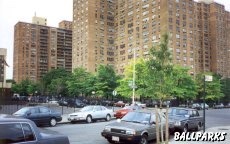
Following the encounter with the Malian, I headed down, in search of the remnants of Ebbets Field, home of the Brooklyn Dodgers. I had looked up the old address, 55 Sullivan Place and went to see what now stood in its place, and to see if there was any kind of marker or plaque or whatever. When I did find it the spot, I discovered that it now was an apartment building, and there was an adjacent school, called Jackie Robinson School (Pre-K through 8), which apparently was Jackie’s home when he was with the Dodgers — and who did I find but the principal, Bruce Copeland standing on the steps, who became my second interviewee. He was a kind man, very willing to talk, with long tied-back dreadlocks, but dressed in nicely pressed slacks who seemed to assume command of the space — and spoke of being on “hallowed ground” in the shadow of Ebbets Field.
Tomorrow, Martin returns from Thailand, and he and Heidi and I drive back up to Hartford, and we all move Nena back to McGill on Saturday.